Jun 1, 2026
—
When it comes to political advertising campaigns, spending more doesn’t always mean reaching more. Sometimes, it just means reaching the same households over and over again while the voters you actually need remain untouched. Political Advertising’s Problem Isn’t Reach; It’s Visibility. Political advertising has never been more complex to execute or harder to evaluate. Voters…
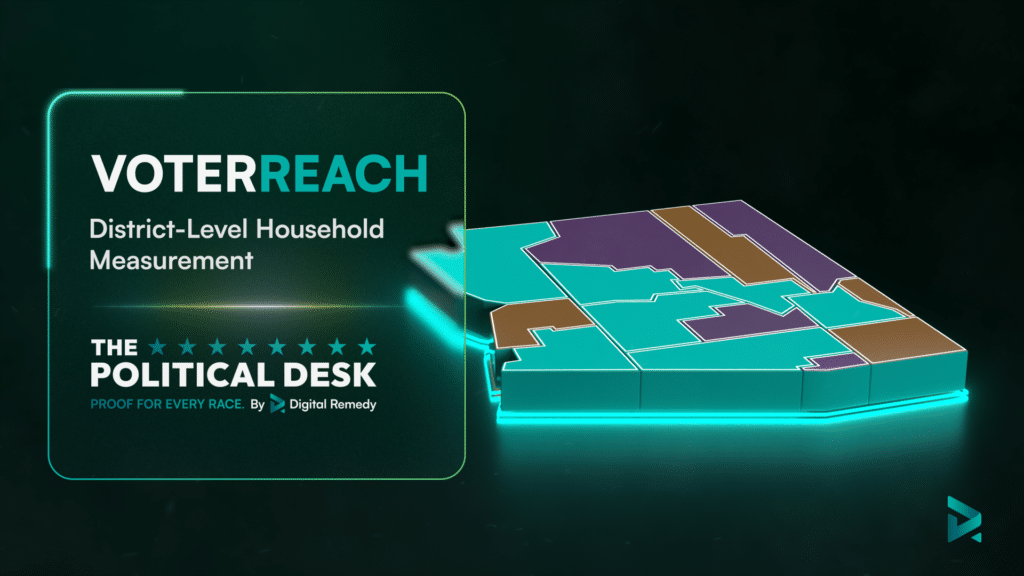
When it comes to political advertising campaigns, spending more doesn’t always mean reaching more. Sometimes, it just means reaching the same households over and over again while the voters you actually need remain untouched.
Political advertising has never been more complex to execute or harder to evaluate. Voters today are moving between streaming TV, social platforms, local news sites, search, and mobile devices throughout the day. No single channel owns their attention. The findings from our recent survey* confirm this.
Voters reported noticing political messaging across social media (54%), local news (39%), and streaming TV (35%).
Unfortunately, the tools most campaigns are using to measure performance were largely built for a simpler, less fragmented world (one where a gross ratings point carried more explanatory weight than it does today). The result is a structural blind spot.
Campaigns often run omnichannel buys across multiple vendors and platforms, seeing their results in separate reports, each measuring something different. They rarely see a unified answer to the most important questions:
One-third of voters say seeing too many political ads makes them less favorable toward a campaign.
This finding alone should stop any media strategist mid-flight. This isn’t just interesting consumer sentiment; it’s a signal of what happens when frequency goes unchecked.
Here’s a reality that sometimes gets lost in the channel-by-channel conversation: elections are not decided nationally. They’re decided in congressional districts, in state legislative seats, in specific counties and zip codes where a few thousand votes can swing an outcome. The geography of political competition is highly local, and it changes from cycle to cycle as competitive ratings shift.
That means aggregate campaign performance data (e.g., total impressions, overall reach, blended cost per thousand) tells only a fraction of the story. A campaign might be achieving strong national or DMA-level delivery numbers while dramatically underinvesting in a competitive district that actually matters, or overexposing a district that’s already locked up.
Nearly 80% of the voters say political messaging should feel relevant to their local community.
If you can’t see how your campaign is performing at the district level, you can’t know whether your message is landing where it counts or whether you’re burning budget in places where the outcome isn’t in question.
More than 60% of voters also say campaigns should prioritize having the right message over simply being on the right platform or appearing more frequently. This reinforces what experienced political media buyers already know intuitively: precision matters more than volume. But precision requires visibility, and visibility requires measurement infrastructure that’s actually built for how campaigns operate and how votes are counted.
The Political Desk, Digital Remedy’s dedicated political division, was built specifically so campaigns, advocacy groups, and issue-based organizations don’t have to retrofit a commercial media partner into the rhythm and demands of a political cycle. The speed and stakes are different, and the reporting needs to match.
Rather than showing campaign delivery through a generic media lens, our VoterReach solution maps household-level data to the political geography that actually determines outcomes — congressional districts, state legislative districts, ZIP codes, counties, and DMAs. It layers in competitive race ratings from Cook Political Report, Inside Elections, and Sabato’s Crystal Ball, so you’re not just seeing where you’re reaching households, but how that reach maps to the seats actually in play.
VoterReach capabilities span the full measurement picture: unique households reached and average frequency by district; device distribution across CTV, mobile, desktop, and tablet; audience overlap across tactics and publishers; cost per unique household; and identification of high-frequency pockets where budget can be reallocated for incremental impact.
Critically, this isn’t a post-election wrap report. It’s intelligence delivered while campaigns can still act on it by shifting budget mid-flight, pulling back where saturation is setting in, and doubling down where competitive districts are underserved.
The capabilities behind VoterReach aren’t theoretical. They’re grounded in The Political Desk’s broader measurement infrastructure and political data network, which includes more than 17 political data partners, 200-plus targeting partners, and voter file integration—all of which are operated by a dedicated team with around-the-clock availability during campaign windows.
When a campaign can see exactly how their media investment maps to congressional and state legislative districts (with competitive race ratings built in), they stop optimizing for easy-to-report metrics and start optimizing for the ones that matter.
As your team plans media for the 2026 cycle, consider what your current reporting actually tells you. If the answer is reach and frequency at the DMA level, a publisher breakdown, and a cost summary, you may be making significant budget decisions without knowing whether your investment is concentrated in the right districts, overserving the wrong ones, or duplicating across channels in ways that don’t translate to incremental voter contact.
Reach out to request a demo to see how district-level measurement works in practice.
*Digital Remedy survey of 1,000 U.S. voters in April 2026.
Related Posts

Picture a dealership’s general manager on a Monday morning. The weekend sales log shows 41 units moved. The programmatic.

If you’re a performance marketer in 2026, you’ve probably noticed the questions getting harder. It used to be enough.

Think about the last time someone opened a new investment account, refinanced a mortgage, or switched insurance carriers on.

